Nature Meets Architecture: Painting the Charm of Riva del Garda (Challenge #207)
Last week during a trip through northern Italy, I spent a day in Riva del Garda, a small town at the northern tip of Lake Garda. What immediately caught my attention was how naturally everything seemed to belong together. Palm trees stood in front of historic facades. Flower beds softened stone plazas. Bougainvillea climbed across walls and windows. Behind all of it rose dramatic mountain cliffs that seemed almost too large for the elegant lakeside town below.
As painters, we often think of landscapes and architecture as separate subjects. We either paint a building or paint nature. Riva del Garda reminded me that some of the most beautiful places are those where the two become inseparable.
That is exactly why I selected these photos for the challenge. None of them are about a single spectacular building or a single dramatic mountain. Instead, they are about relationships: between flowers and stone, trees and facades, mountains and streets, nature and human design. The charm of the place comes from how all these elements work together.
Lake Garda itself is a fascinating region because it sits at the meeting point of different worlds. The lake creates a mild Mediterranean climate that allows palm trees, olive trees, and flowering plants to thrive, while the surrounding mountains provide a distinctly alpine backdrop. The result is a landscape unlike almost anywhere else in Europe.
Focus Point: Nature Meets Architecture
One of the challenges artists face when painting towns, villages, and gardens is making all the elements feel connected. Buildings can easily look pasted into a scene, while vegetation can become an unrelated foreground decoration.
Strong paintings usually create visual harmony between natural and man-made elements. This can happen through shared colors, repeated shapes, overlapping forms, or carefully balanced areas of detail.
In Riva del Garda, the architecture doesn't compete with nature. Instead, both support each other. The flowers make the stone feel warmer. The buildings provide structure among the organic shapes. The mountains create a dramatic backdrop that unifies everything.
As you work through these photos, consider not only what you are painting but also how the natural and architectural elements interact.
If you'd like to dive deeper into related topics, you may also enjoy:
Linear Perspective: useful for understanding streets, buildings, and architectural structure.
Don't Paint Every Leaf: Mastering Mass vs. Detail in Landscape Art: especially helpful when simplifying flowers, trees, and foliage without losing their character.
Photo Analysis
The four photos below offer different versions of the same visual idea: architecture surrounded, softened, and enhanced by nature. As you study them, look for ways the buildings, flowers, trees, and mountains support one another rather than compete for attention. Notice where your eye travels first and how the different elements work together to create a sense of place.
Photo 1: Palm Tree Fountain in the Piazza
This photo shows a large palm tree rising in front of a small fountain surrounded by bright pink flowers. Elegant Italian buildings frame the square, while the mountain wall behind the town creates an impressive natural backdrop.
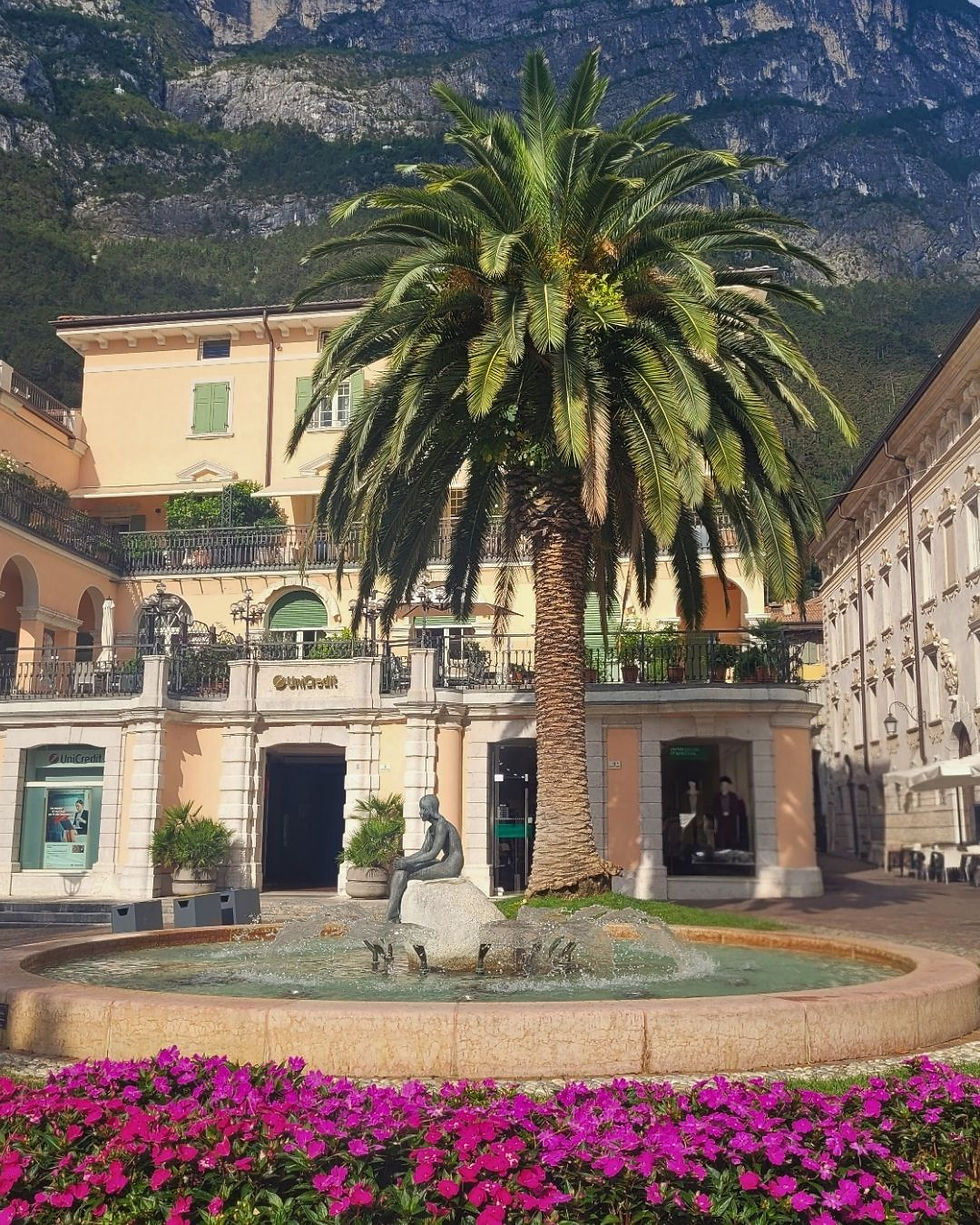
Challenge as a Photo: The palm tree is visually dominant and sits close to the center of the composition. At the same time, there are many competing elements: flowers, architecture, shadows, and mountains. The challenge is deciding what deserves attention and what should be simplified.
Focus Questions
Is the palm tree your main focal point, or is it part of a larger story about the square?
How much detail do the buildings really need?
Can the mountain remain a supporting shape rather than becoming a distraction?
Painting Tips
Group flowers into larger color masses before adding individual blooms.
Simplify the mountain into broad value shapes.
Use the palm tree silhouette to create a strong focal area.
Allow architectural details to become softer as they move away from the center of interest.
Photo 2: Mountain Road and Historic Facades
This photo shows a quiet street curving through colorful buildings and flowering gardens, with dramatic mountain slopes rising directly behind the town.

Challenge as a Photo: The scene contains several visual layers that compete for attention. The mountains are enormous, the buildings are colorful, and the flower beds create strong foreground interest. Creating a clear hierarchy is essential.
Focus Questions
Which element tells the story of the scene?
How can the road guide the viewer through the painting?
What role should the mountains play in the final composition?
Painting Tips
Use the curve of the road as a leading line.
Keep mountain textures simpler than foreground details.
Repeat colors from the flowers within the buildings to unify the scene.
Consider slightly exaggerating atmospheric perspective in the background.
Photo 3: Tower, Garden, and Lake
This photo shows a historic stone tower overlooking colorful flower beds, lakeside greenery, and distant mountain views.

Challenge as a Photo: This image contains many attractive subjects. The tower, flowers, water, boats, and mountains all compete for attention. Without simplification, the painting can easily become fragmented.
Focus Questions
What is your true focal point?
How can the flower beds support the tower rather than compete with it?
Which elements could be simplified or removed?
Painting Tips
Use the tower as an anchor for the composition.
Group flowers into larger masses of color and value.
Keep distant mountains soft and understated.
Use color repetition between the foreground and middle ground to create harmony.
Photo 4: Bougainvillea and Blue Shutters
This photo shows vibrant bougainvillea cascading around a doorway with blue shutters, creating a beautiful interaction between vegetation and architecture.

Challenge as a Photo: The abundance of flowers can tempt us to paint every blossom individually. At the same time, the architectural elements risk becoming secondary despite providing the structure that makes the composition work.
Focus Questions
How much detail is necessary in the flowers?
Can the doorway act as a visual resting point?
How do the organic shapes interact with the straight architectural lines?
Painting Tips
Paint the bougainvillea as interconnected masses before adding accents.
Use the blue shutters as a color contrast against the warm wall and flowers.
Look for opportunities to lose edges within the foliage.
Let the architecture provide structure and rhythm within the composition.
I hope these photos inspire you to explore the beautiful balance between nature and architecture that makes Riva del Garda so memorable. Whether you're drawn to the palm-lined piazza, the colorful lakeside streets, the historic tower, or the bougainvillea-covered doorway, don't be afraid to make the scene your own.
To be considered for a feature on the Landscape Art Club Instagram account, post your artwork by Monday, 29 June 2026, 12:00 CET, use the hashtag #LandscapeArtClub207, and tag @landscapeartclub or invite us as a collaborator. Since Instagram hashtags are becoming less reliable, the collaborator option is the best way to make sure I don't miss your work.
I can't wait to see your interpretation of Riva del Garda.
Happy painting!


Comments