Painting Architecture with Character (Weekly Challenge #204)
This week we explore one of the most iconic examples of modern architecture of the Guggenheim Museum in Bilbao, Spain. These reference photos were taken by Judith @judithcrowleyart during a visit to this remarkable place, where architecture becomes more than just a structure. It becomes an experience. The building seems to shift depending on where you stand: curved metallic surfaces catch the light, reflections ripple in the water, and strong shapes interact with the surrounding city.
What makes this location especially interesting for painters is not just the building itself, but the contrast between structure and environment, between flowing curves and rigid lines, reflective surfaces and solid forms, light and shadow. This week invites you to explore how to translate a powerful architectural form into a painting.
Focus Point: Modern Architecture
Architecture in landscape painting is not just about accuracy, it’s about character. Unlike natural forms, buildings are defined by structure, edges, and intentional design. But when placed into a landscape, they interact with light, atmosphere, and surroundings in expressive ways.
In the Guggenheim, we see something different:
flowing curves vs sharp edges
reflective surfaces vs solid masses
light vs shadow shaping the form
bold structure vs surrounding space
The challenge is to decide, what defines the building visually? How much detail is necessary? How can you simplify without losing its identity? Not an easy challenge, but definitely exciting!
If you want to refresh your knowledge about the linear perspective, check Linear Perspective Made Easy: A Beginner's Guide for Artists.
Photo Analysis
Photo 1: Reflective Surfaces and Sculptural Forms
The museum’s curved metallic surfaces rise behind a reflective water feature with a sculptural installation.

Challenge: There are many competing elements: reflections, sculpture, architecture, and color accents. The difficulty is simplifying the scene while maintaining the strong identity of the building.
Focus Questions
Which shapes define the architecture most clearly?
How do reflections repeat or distort those shapes?
What can be simplified without losing the structure?
Painting Tips
Reduce the building into large, flowing shapes first.
Treat reflections as softer, simplified versions of forms.
Limit small details in the sculpture.
Use light to separate planes instead of outlines.
Photo 2: Architecture and Urban Context
The museum is seen together with a bridge and river, creating a layered urban composition.

Challenge: Multiple strong structures compete for attention. The challenge is organizing the composition so the viewer’s eye knows where to go.
Focus Questions
Which structure is the main focal point?
How do horizontal and vertical elements interact?
How can you simplify the background?
Painting Tips
Choose one dominant structure and subordinate others.
Simplify the bridge into clear directional lines.
Use value contrast to guide the eye.
Reduce background complexity.
Photo 3: Curves, Light, and Scale
Large curved surfaces dominate the scene, catching light and creating smooth transitions.
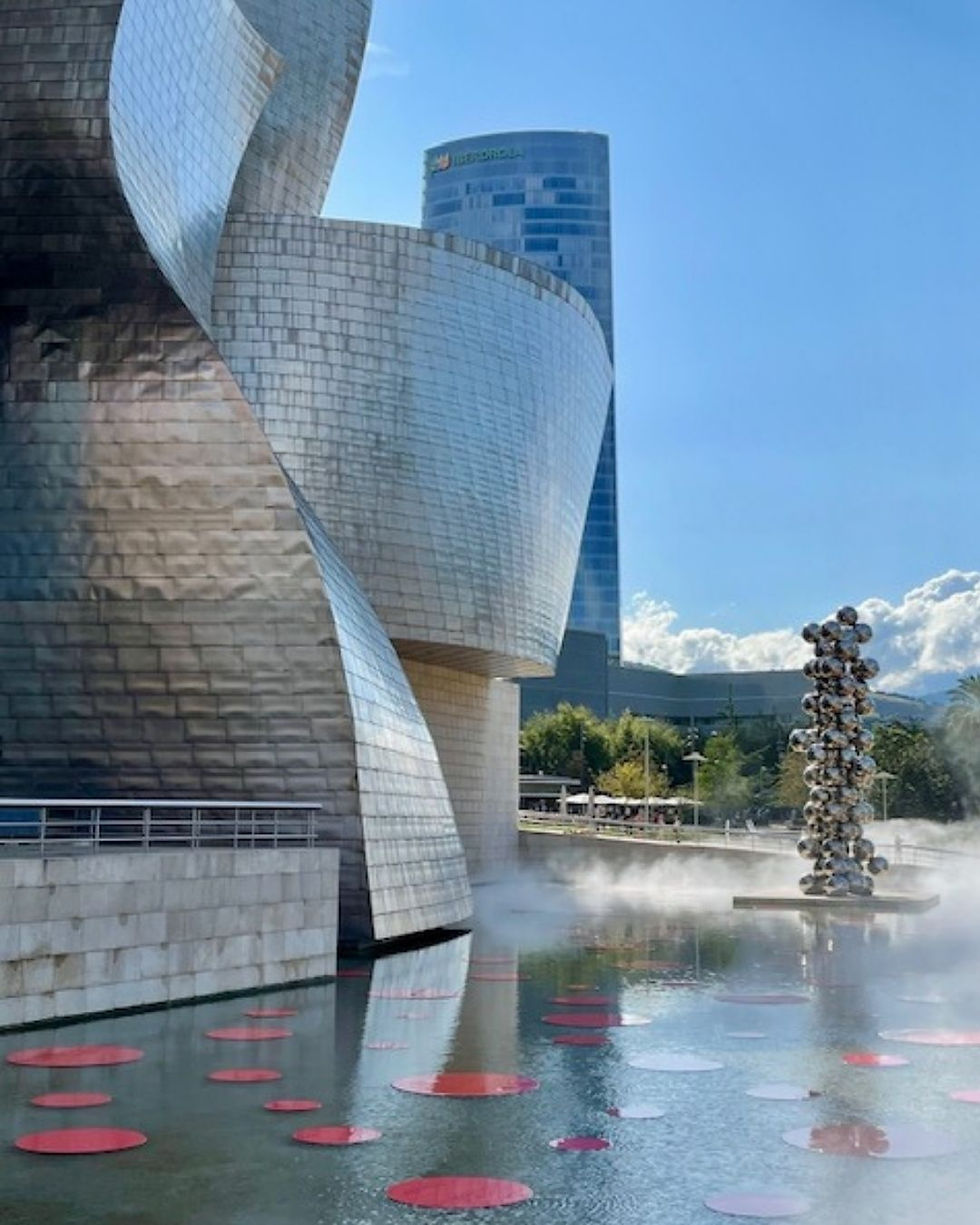
Challenge: The building lacks obvious straight edges, making structure harder to define. The challenge is expressing form through light and value instead of line.
Focus Questions
How does light describe the form of the curves?
Where are the strongest value shifts?
How can you avoid flattening the shape?
Painting Tips
Use gradients of value to describe curvature.
Avoid outlining, let light define edges.
Simplify surfaces into broad planes.
Keep transitions soft but intentional.
Photo 4: Sculpture and Scale Interaction
A large sculpture stands in the foreground with people walking beneath it, with the bridge behind.

Challenge: Scale becomes the key difficulty. The sculpture, people, and architecture must relate convincingly without distortion.
Focus Questions
How do people help define scale?
Which elements should be simplified most?
How can you keep clarity in overlapping forms?
Painting Tips
Use people as scale references, not focal points.
Simplify the sculpture into strong structural lines.
Avoid over-detailing secondary elements.
Keep overlaps clean and readable.
This week is about learning to see architecture not just as structure, but as a visual statement. Instead of trying to capture every detail, focus on what gives the building its identity: its shapes, light, and relationships with space.
Allow yourself to simplify boldly, and let the painting express the character of the place rather than its exact form.
Share your artwork by Thursday, 30 April 2026, 23:59 CET, using #landscapeartclub204 and tagging @landscapeartclub on Instagram.
Happy painting!


Comments