Painting Iconic Silhouettes in Landscape Art: When Shape Becomes Identity
Some landscapes contain forms so recognizable that they can be identified instantly even when reduced to a simple outline. Think of Mount Fuji rising above the horizon, the Eiffel Tower cutting into the Parisian sky, or the unmistakable skyline of New York. Even without detail, these forms remain recognizable because their silhouette carries their identity.
In landscape painting, artists often face a choice: render every architectural detail faithfully, or focus on the essential shape that defines the subject. The stronger the silhouette, the less detail is required to communicate the place.
Few landmarks demonstrate this better than Mont Saint-Michel, the medieval abbey rising dramatically from the tidal flats of Normandy. Over time, artists have depicted it in very different ways from careful realism to expressive simplification, yet its identity always remains clear.
Let's check few examples, which show how artists gradually move from observational detail toward simplified silhouette, revealing how powerful shape can be in landscape composition.
From Detail to Design: Four Artistic Approaches
Clarence Alphonse Gagnon — Observing the Landmark

Clarence Alphonse Gagnon’s Mont Saint-Michel, Morning presents the landmark in a relatively naturalistic way. The structure of the abbey is carefully observed: walls, towers, and surrounding buildings are rendered with clarity, while figures crossing the tidal flats add a sense of everyday life.
Here the viewer reads the scene largely through detail and narrative context. The architecture is recognizable because the painter records many of its structural elements. The silhouette exists, but it is supported by observation rather than simplification.
This approach reflects a traditional way of painting landmarks: the artist documents the place faithfully, allowing viewers to appreciate both the structure and its surrounding atmosphere.
Yet as modern artists explored color, light, and perception, many began simplifying these complex structures. The emphasis gradually shifted from accurate description toward visual design.
Paul Signac — Simplifying the Structure

In Paul Signac’s interpretation of Mont Saint-Michel, the architectural detail becomes less important than color and structure. Painted in the pointillism style, the scene is built from small dots of color that vibrate across the surface of the canvas. Instead of focusing on windows, walls, and architectural precision, Signac simplifies the abbey into broader masses of light and color.
The landmark remains immediately recognizable, but now largely because of its overall form the pyramid-like rise of the abbey from the surrounding landscape. At this stage, the viewer begins to recognize the subject primarily through shape rather than detail. The silhouette starts to dominate the reading of the image.
This shift demonstrates an important lesson for painters: once the major structure of a landmark is established, the eye can identify it even if many details disappear.
Claude Monet — Architecture as Atmosphere
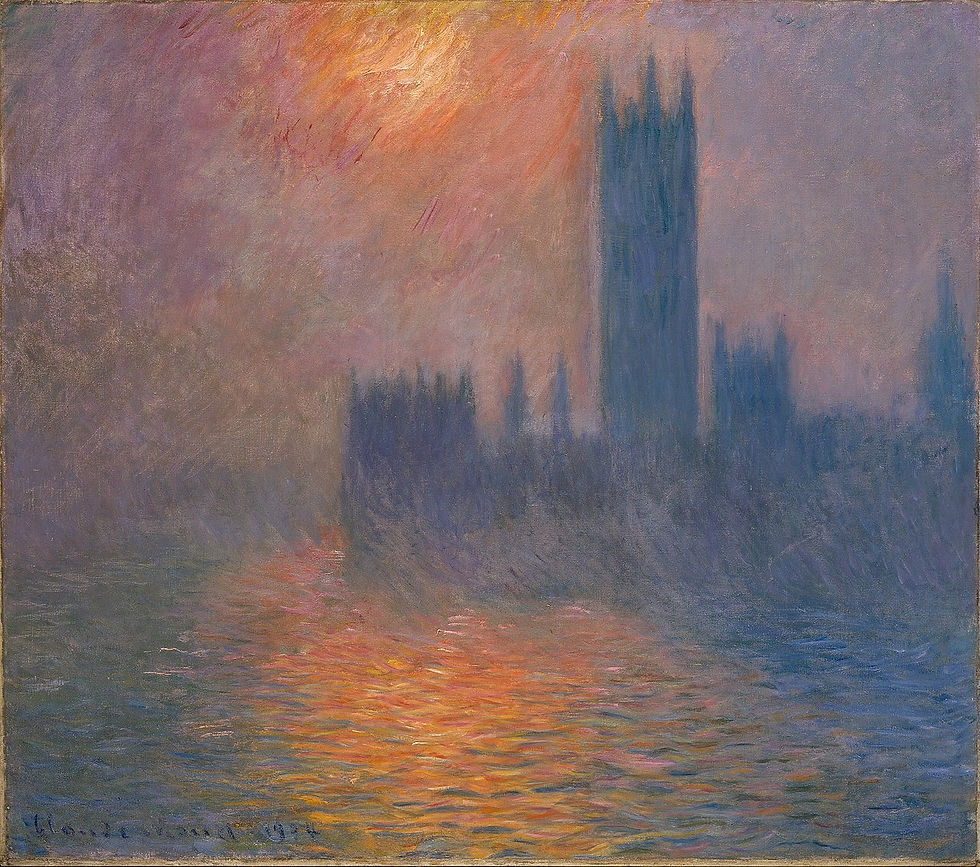
Claude Monet pushes this idea even further in his famous paintings of the Houses of Parliament in London. Here, architecture dissolves into atmosphere. The building becomes a dark mass emerging from fog and glowing light, while reflections ripple across the river surface. Most architectural details vanish entirely. Yet the structure remains recognizable because its silhouette stands clearly against the sky.
This approach reflects the Impressionist interest in capturing fleeting light rather than precise architectural description. The painting focuses on mood and atmosphere, allowing the viewer’s mind to reconstruct the building from its outline. Monet’s work demonstrates how a strong silhouette allows artists to prioritize light, color, and atmosphere, without losing the identity of the subject.
Marc Chagall — When Silhouette Becomes Symbol

In Marc Chagall’s The Big Wheel, the Eiffel Tower appears in a dreamlike Parisian scene filled with bold color and expressive shapes. Perspective is distorted, the composition feels almost surreal, and the tower itself is simplified into a slender triangular form. Yet viewers instantly recognize the structure. The reason is simple: the Eiffel Tower possesses one of the most recognizable silhouettes in the world.
Even in stylized or imaginative interpretations, the outline remains unmistakable. This demonstrates how powerful iconic shapes can be in visual culture. Once a silhouette becomes widely known, artists can reinterpret it freely without losing its identity. In this way, the silhouette transforms from architectural form into visual symbol.
Practical Tips for Painting Iconic Silhouettes
When working with recognizable landmarks or strong natural forms, focusing on silhouette can help create clearer and more powerful compositions. And here are some tips which could help to bring the iconic silhouettes in your paintings to the next level :
1. Start with the main shape
Before adding detail, block in the overall silhouette of the subject. Ask yourself whether the landmark would still be recognizable from its outline alone.
2. Simplify complex structures
Buildings often contain countless architectural details. Reduce these to larger masses and avoid overworking small elements that do not contribute to the overall form.
3. Use the sky to define the silhouette
The edge where a structure meets the sky is crucial. Strong contrast between sky and subject helps the silhouette remain clear and readable.
4. Group details into larger forms
Instead of painting every window or stone, group details into tonal masses that support the larger shape of the structure.
5. Test the silhouette from a distance
Step back from your painting or squint your eyes. If the landmark remains recognizable even when details disappear, the silhouette is working.
From Gagnon’s careful observation to Chagall’s expressive stylization, these paintings show how artists gradually shift from describing a place to designing its visual identity.
The more recognizable a form becomes, the more freedom artists gain to interpret it. For painters this offers a valuable reminder: sometimes the most important part of a subject is not its detail, but its shape against the sky.
Happy painting!


Brilliant tutorial with well chosen examples. Very helpful,thank you, Natalia!