Painting the Distance: Air Perspective in Yosemite (Challenge #211)
Some landscapes become famous because of paintings. Others inspire generations of painters because of the experience of standing there. Yosemite National Park belongs to the second group. Its towering granite cliffs, crystal-clear alpine lakes, and ancient forests have fascinated artists, photographers, and nature lovers for more than 150 years.
This week's beautiful reference photos were kindly shared by @walkingnewzealand, who reached Tenaya Lake after a three-day hike through Yosemite's high country. Sitting at an elevation of 2,484 metres (8,150 feet), the lake rewards the effort with calm reflections, polished granite domes, and an incredible sense of space. The remaining photos show two of Yosemite's most iconic landmarks Half Dome and El Capitan, whose monumental forms have inspired generations of landscape artists.
When I saw Ida's photographs, I immediately knew they would make a wonderful challenge. At first glance they seem peaceful and straightforward, but they hide one of the biggest challenges in landscape painting: conveying the enormous scale of the scenery. The mountains are massive, yet much of their impact comes not from detail, but from how they gradually dissolve into the atmosphere. That is exactly why I chose this week's focus point.
Focus Point: Air Perspective
One of the easiest ways to make a landscape painting feel flat is to paint every part of the scene with the same amount of contrast, colour intensity, and detail. In reality, our eyes don't see the world that way. The farther an object is from us, the more the atmosphere softens its colours, reduces its contrast, and blurs its edges. This phenomenon known as air perspective, or atmospheric perspective is one of the most powerful tools for creating convincing depth.
Yosemite is an ideal place to study this effect. Every photograph in this week's selection contains multiple layers of space: reflections on the lake, forests, granite cliffs, and distant mountains fading into the blue sky. Rather than trying to paint every tree or every crack in the rock, ask yourself how you can use these gradual transitions to lead the viewer deeper into the landscape.
If you'd like to explore this topic in more detail before you start painting, I recommend reading Why Air Perspective is Essential in Landscape Art, where I explain why distant landscapes appear cooler, softer, and less detailed, and how you can use these observations to create a stronger sense of depth in your own work.
As always, remember that these photographs are a starting point rather than something to copy exactly. Feel free to adjust the composition, simplify the landscape, strengthen the atmosphere, or even change the lighting if it helps communicate the feeling of standing in Yosemite.
Photo Analysis
Every landscape tells its own story, even when photographed in the same national park. Some scenes invite you to focus on atmosphere, while others challenge you with scale, reflections, or dramatic rock formations. As you explore this week's references, look beyond the iconic landmarks and ask yourself how each photograph creates a sense of distance. Which elements belong to the foreground, middle ground, and background? Where does the atmosphere begin to soften the landscape? Thinking about these questions before you start painting will help you make more intentional artistic decisions.
Photo 1: Tenaya Lake with Autumn Colours
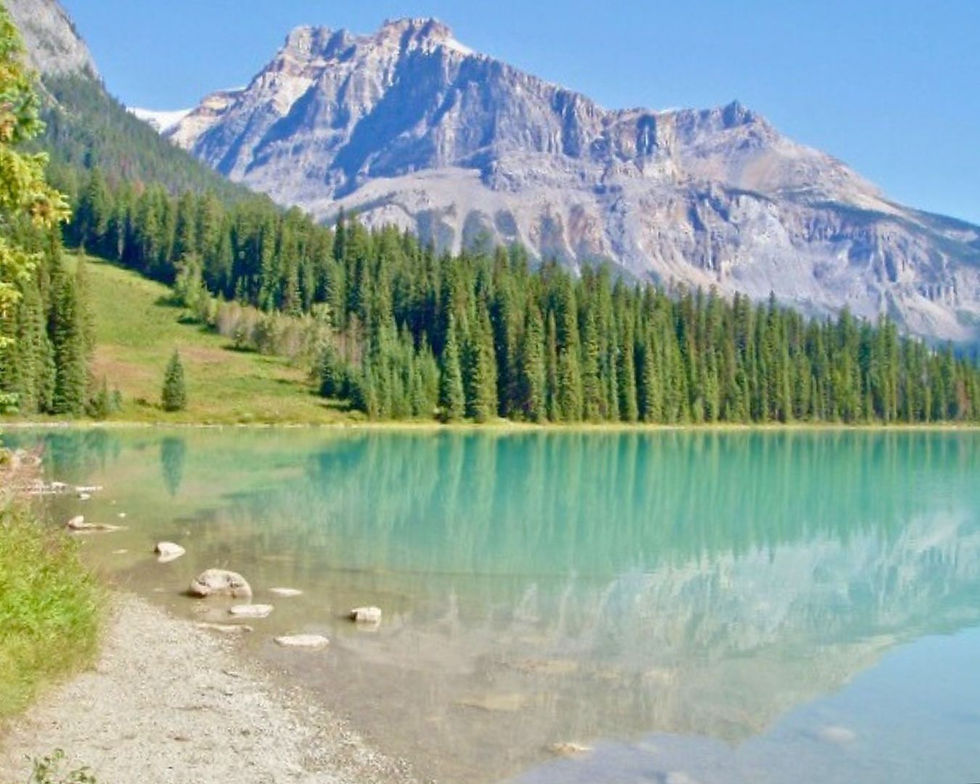
This peaceful view of Tenaya Lake combines colourful autumn shrubs, smooth granite boulders, calm reflections, evergreen forest, and pale granite domes. Although the foreground is rich in colour and detail, the eye naturally travels through several layers before reaching the distant mountains.

Challenge as a Photo: The variety of elements makes it tempting to paint everything with the same clarity. The real challenge is creating convincing depth through gradual atmospheric changes.
Questions to Consider
Which landscape layer appears closest, and which feels farthest away?
How do colour temperature and saturation change from the foreground to the distant granite domes?
Which edges could become softer to increase the illusion of distance?
Painting Tips
Keep the foreground vegetation warm, colourful, and detailed.
Reduce contrast and simplify textures in the forest before reaching the mountains.
Shift the distant granite slightly cooler and lighter than the foreground rocks.
Paint reflections with slightly lower contrast than the objects they mirror to preserve atmospheric calm.
Photo 2: Half Dome from the Trail
Seen from a hiking trail, Half Dome rises dramatically above the valley while trees and rocky slopes create several intermediate layers. The enormous granite face dominates the composition, but its scale is reinforced by the atmosphere surrounding it.
Challenge as a Photo: Because Half Dome is so impressive, it's easy to overwork its textures. Instead, use air perspective to separate the mountain from the surrounding landscape.

Questions to Consider
Which mountain planes appear closest, and which begin to disappear into the atmosphere?
How does the distant granite differ in colour from the foreground rocks?
Which details become unnecessary once the mountain recedes into the distance?
Painting Tips
Keep foreground rocks and vegetation crisp with stronger value contrast.
Simplify the distant mountain into broader value shapes.
Introduce cooler blue-grey tones where the atmosphere separates one ridge from another.
Let atmospheric softness create depth instead of outlining every surface.
Photo 3: El Capitan in Evening Light
Warm sunlight illuminates El Capitan while the forest below remains in cooler shadow. The lighting creates a dramatic separation between foreground, middle ground, and background, making this an excellent study of depth.
Challenge as a Photo: The spectacular light can distract from the atmospheric effects that make Yosemite feel immense. The atmosphere is just as important as the sunlight.

Questions to Consider
How does the warm light affect the feeling of depth?
Which distant areas lose contrast even though they are brightly lit?
How can you prevent the background cliffs from competing with the foreground?
Painting Tips
Reserve your strongest contrast for the nearest illuminated planes.
Allow distant cliffs to become progressively softer and cooler.
Use subtle colour shifts rather than additional detail to describe distance.
Let the forest act as a transitional layer between foreground and mountain.
Photo 4: Wide View Across Tenaya Lake
This wider view of Tenaya Lake feels calm and spacious. The tiny figures standing near the centre immediately communicate the scale of Yosemite, while the repeating bands of water, forest, and granite naturally demonstrate atmospheric depth.
Challenge as a Photo: Its simplicity can encourage over-detailing. In reality, this scene succeeds because large areas remain quiet, allowing the atmosphere to do much of the work.

Questions to Consider
How many distinct depth layers can you identify?
How does the atmosphere change the appearance of the distant mountains?
How can the tiny figures strengthen the viewer's perception of scale and distance?
Painting Tips
Build the painting in clear foreground, middle-ground, and background layers.
Gradually decrease saturation and edge sharpness as forms recede.
Keep the distant mountains lighter and cooler than the foreground rocks.
Use the small figures to emphasize the immense scale created by atmospheric perspective rather than adding more detail.
Yosemite has inspired artists for generations, not because every painter copied the scenery exactly, but because each interpreted its atmosphere, light, and immense sense of space in a personal way. I hope these reference photos encourage you to do the same. Don't be afraid to adjust the composition, simplify the landscape, or even change the lighting if it helps you communicate the feeling of standing among these remarkable granite giants.
I can't wait to see your interpretations! Share your artwork by Monday, 24 August 2026, 12:00 CET, using #LandscapeArtClub211 and invite @landscapeartclub as a collaborator (or tag us) for a chance to be featured.


Comments